
What Defined November 2025: A Digest of Canadian Gambling News

At the beginning of each month, we traditionally sum up the previous period by reviewing the most notable developments in Canadian online gambling and sports betting. In this digest, we discuss how Ontario’s iGaming sector keeps breaking records, why senators are stepping up efforts against match-fixing, and how federal authorities are again debating stronger controls over betting advertising. We also look at legal decisions that open new opportunities for Ontario players, as well as Alberta’s ongoing preparations for launching a regulated iGaming market.
October becomes the best month in Ontario iGaming history
October 2025 will go down as the most successful month ever for Ontario’s iGaming industry. The province set several new records, showing exceptional momentum in the growth of its regulated market.
Players placed a total of $9.2 billion in cash wagers, marking the third consecutive month of record highs. Compared to September, this is an 8% increase, and compared to October 2024, a remarkable 24% rise. Online casinos continue to dominate, accounting for about 85% of all wagers, with a total volume of $7.9 billion.
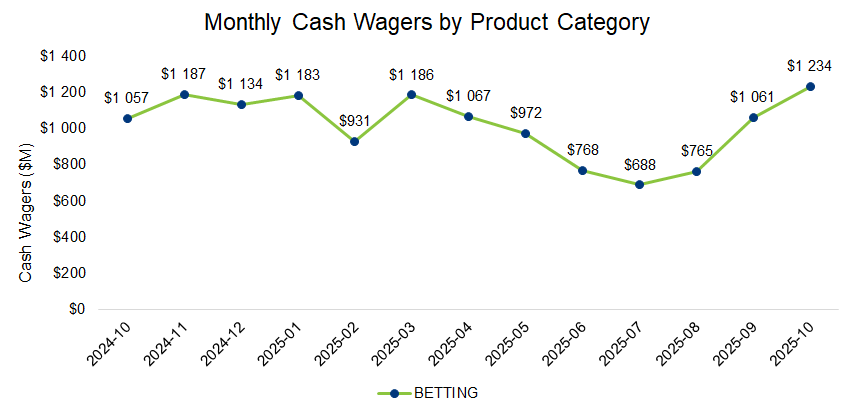
Gross gaming revenue reached $367.7 million, exceeding the previous record from May 2025 by 9%. This figure is also 38% higher than the same month a year earlier. Sports betting performed strongly as well, thanks to active NBA and NHL seasons – wagers totalled $1.23 billion, up 16% year over year.
The number of active player accounts climbed to 1.29 million, a 36% increase from October 2024. Average revenue per active account reached $286, showing higher player engagement.
Interestingly, online poker saw a drop in wagering volume (-9% compared to September) but an increase in revenue (+10%). This may reflect pricier tournaments or adjustments in rake structure. In any case, these trends suggest the market is ready for international liquidity – something we discuss next.
The court allows Ontario players to compete against international opponents
On November 12, the Ontario Court of Appeal issued a historic ruling: regulated iGaming platforms in the province may legally allow players to compete against opponents located outside Canada. The decision passed with a 4:1 majority. Chief Justice Michael Tulloch wrote that the ruling is based on the court’s interpretation of the Criminal Code, and the majority concluded that “online gaming and sports betting would remain lawful” under Ontario’s proposed model.
This decision has the potential to transform peer-to-peer games such as online poker and daily fantasy sports (DFS). Currently, participation is restricted to Ontario residents only, which limits prize pools and reduces appeal for serious players. Many Ontario poker players and gamers bypass provincial platforms and choose international sites to access higher-stakes games. The ruling could bring these users back to the regulated environment, increasing provincial revenue. It would also benefit poker players directly, as they would be protected by the regulatory system and able to resolve disputes within the province. We wrote earlier about ways to protect your account.

However, the decision is not final. The Canadian Lottery Coalition – representing gaming agencies from seven provinces (BC, Saskatchewan, Manitoba, and the four Atlantic provinces) – opposed Ontario’s model. There is a chance they may appeal to the Supreme Court of Canada.
IBIA and PFA continue their fight against match-fixing in Canadian soccer
The International Betting Integrity Association (IBIA) and the Professional Footballers’ Association (PFA) Canada have completed the second year of their joint education program against match manipulation. In 2025, nearly 200 players and staff from all eight Canadian Premier League (CPL) clubs participated in integrity training. The program is funded by a three-year, $300,000 investment from IBIA and its members – bet365, Betway, and FanDuel. The goal is to give Canadian athletes free access to information about the risks associated with match-fixing.
IBIA’s “Protecting the Integrity of the Game” program is built around the 3Rs: rules, responsibility, and reporting. The sessions teach players and coaches how to identify, avoid, and report attempts to manipulate results. IBIA and PFA Canada plan to continue working together in 2026 and expand the initiative to other Canadian sports organizations.
“Preventing sports betting-related match-fixing starts with educating the athletes and coaches,” said IBIA CEO Khalid Ali. Callum Irving, captain of Vancouver FC, noted that the training was “super informative” and provided essential knowledge about betting rules and the consequences of dishonest behaviour.
This effort deserves significant recognition. In recent years, we have seen match-fixing scandals across multiple leagues worldwide, including the NBA and MLB. We covered these cases previously. Canadian soccer is taking proactive steps to protect its league before the issue becomes more serious.
Senators call for a ban on sports betting advertising due to youth risks
More than 40 Canadian senators have appealed to Prime Minister Mark Carney, urging a nationwide ban on sports betting advertising. In their letter, sent by Sen. Percy E. Downe and Sen. Marty Deacon, they ask the federal government to use all legislative and regulatory tools to introduce restrictions similar to those applied to cigarette advertising.
The issue intensified after the legalization of single-event sports betting in 2021. Canadians are now exposed to a “flood” of gambling ads. A CBC investigation found that nearly one-fifth of sports broadcasts consist of betting-related promotions.
Doctors and mental health specialists are sounding the alarm. Dr. Shawn Kelly, a pediatrician with the Canadian Society of Addiction Medicine, described an incident when his seven-year-old son, while watching a hockey game, asked him about the difference between “over-under” and “plus-minus.” “It was pretty shocking,” the doctor admitted.

Even if the ads are not directly aimed at children, young viewers still see them and absorb the message that betting is a normal part of watching sports. Research shows that such exposure increases the risk of developing gambling addiction later in life.
The Senate has already approved Bill S-211, which proposes limits on the volume, scale, and placement of sports betting ads. Suggested measures include banning advertising during game broadcasts, restricting gambling-sponsored shows, and prohibiting in-app promotions during live events.
Alberta continues preparations for its iGaming rollout
Alberta is actively moving toward launching its own regulated market for online betting and casino gaming. The provincial government has announced the recruitment of board members for the new Alberta iGaming Corporation (AiGC), which will operate similarly to iGaming Ontario. AiGC will be responsible for contracting private operators such as DraftKings and FanDuel, which will be allowed to offer sports betting, online slots, and other products.
The launch was originally planned for late 2025, but was later pushed to early 2026. However, many operators now expect the market to open only in the second half of 2026. Dale Nally, the minister responsible for iGaming, said that the final regulatory framework will be completed soon and that more details about AiGC will be released in early 2026.
Several issues still need resolution before launch: tax rates, advertising rules, whether Alberta will seek shared liquidity with Ontario, and more. At the moment, the only licensed iGaming platform in the province is PlayAlberta.ca, operated by Alberta Gaming, Liquor & Cannabis (AGLC).
With over 4 million residents, Alberta will not match Ontario’s market size, but it has clear advantages. First, it can learn from Ontario’s mistakes and build a more streamlined regulatory structure. Second, it can attract operators already active in Canada and ready to expand quickly into a new province.
Relevant news

Updated Gambling Support System in British Columbia Explained
British Columbia ranks third in population among Canadian provinces and continues to show steady economic…

Bet365 and UFC Join Forces: What Canadian Bettors Should Know
The way people watch sports and bet on them is changing fast. In early 2026,…
What Happened in Canadian Betting: February 2026
The sports betting landscape in Canada continues to shift month by month. What happens behind…

What’s Holding Quebec Back From a Competitive Betting Market?
While 73% of Quebec residents play on offshore sites, the province loses more than $300…
January 2026 Highlights: Bet365 Partnership and Other Canadian Betting Updates
The beginning of the year is not always rich in news, but that is not…

New Online Sports Betting Standards in Alberta
On January 13, 2026, Alberta Gaming, Liquor and Cannabis (AGLC) published an 85-page document titled…