
How Technology Is Transforming Online Sports Betting in Canada

Just ten years ago, placing a bet on a match meant visiting a sportsbook website, selecting an outcome, and confirming the wager. Today, the process looks completely different. After the legalization of single-event betting in 2021, the Canadian market grew rapidly. According to Grand View Research, it is expected to reach $8.8 billion by 2030 with a CAGR of 13.6% from 2025 to 2030. Technology has played a major role in this rapid expansion, fundamentally reshaping how Canadians place wagers online.
Mobile apps: the modern bettor’s main tool
Mobile betting has long since stopped being an alternative to websites – it has become the standard. Every major bookmaker now offers apps whose functionality largely matches that of its online platform. Push notifications alert users about match kickoffs, odds changes, and limited-time offers. Withdrawals run through convenient channels such as Interac and e-Transfer. Funds arrive quickly, sometimes within just a few hours.
Usability is the primary advantage of mobile sportsbooks. The interface is intuitive even for beginners, and placing a wager takes only seconds. Key events appear on the main screen, while the search function makes it easy to find a specific sport. Some apps feature built-in streaming – users can watch NHL and NBA games directly inside the service. Recommendation systems analyze previous activity and suggest betting options based on user interests.
The biggest shift is not convenience alone, but the fact that market access is now open 24/7 from anywhere with an internet connection. This changes behaviour: people react faster to events and place wagers more frequently. Such accessibility can become problematic, especially for those predisposed to gambling addiction. We covered this issue in detail in a separate article.
In-play wagering: the engagement accelerator
In 2025–2026, live betting became a key driver of user retention on online platforms. It keeps audiences engaged longer, turning passive viewing into active participation. Previously, wagers were limited to pre-match predictions. Now every action on the field creates an opportunity. A goal scored? Weather changed? Coach made a substitution? All of it affects the odds. Bettors watch the game and respond instantly, which increases excitement. There is no need to switch to a bookmaker’s site – everything is available in one window.
A clear example is BetVision by Genius Sports. This is the world’s first platform where live streaming and betting are combined within a single interface. Users watch the match, see odds overlaid on the broadcast, and place wagers without leaving the video player. The Touch-to-Bet feature allows viewers to tap a player directly on screen and instantly receive prop markets and statistics. The product launched for the NFL in 2023, and in 2025 added soccer and basketball – with partners including DraftKings, FanDuel, and Caesars Entertainment.
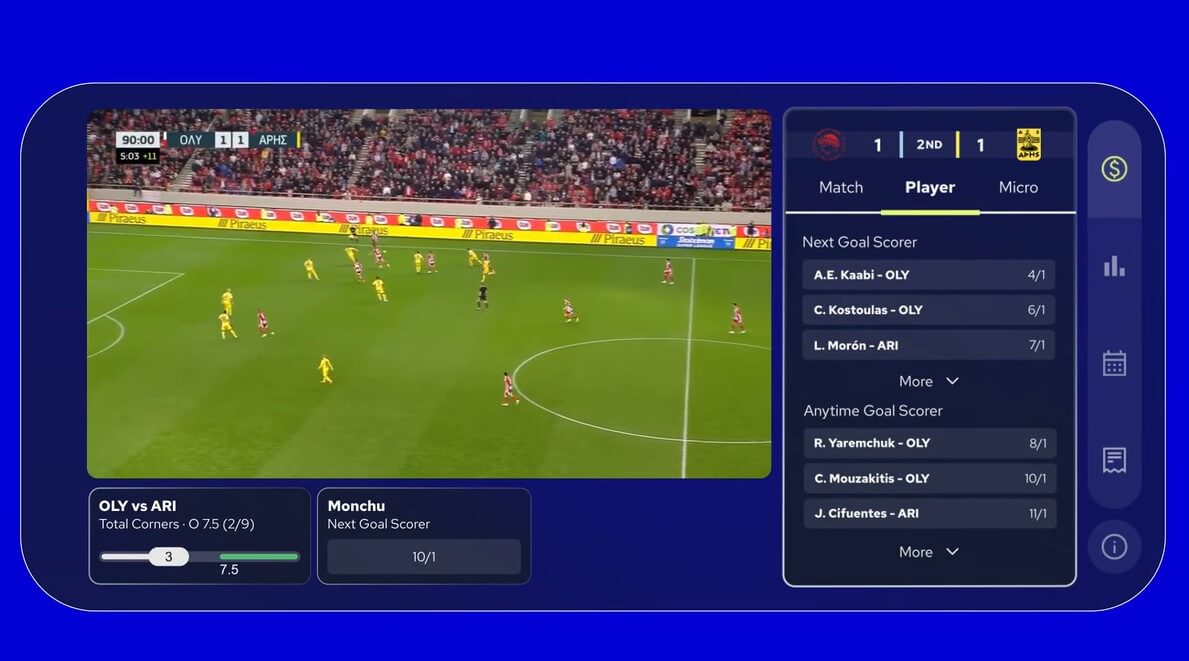
Canadian bookmakers currently offer more basic streaming versions, but the direction is promising. In the future, Canadian bettors may gain similar tools that allow them to watch and wager within a single interface.
Live betting data: where the odds come from
Behind every odds movement stands an entire industry. Data from the field does not reach the app instantly – it passes through a full chain: player tracking, processing, statistical modelling, and only then appears on the bettor’s screen.
This work is handled by specialized live data suppliers. For example, Genius Sports is the official data supplier for the NFL and the Premier League. Meanwhile, Sportradar processed data from nearly one million sporting events in 2024. Every significant match event – a goal, red card, or injury – triggers an automatic probability recalculation. Automated systems capture the moment and send it to models without human involvement. All this information flows to bookmakers via API – data streams with minimal delay. That is why odds shift within seconds.
For bettors, this means one thing: today’s live markets are built on algorithms that react faster than any human. Five years ago, the live betting screen showed the score, timer, and a few markets. Today, the same screen may offer dozens of micro-markets based on player tracking: next pass, next three-pointer, second-half distance covered. Now, there are more betting opportunities, but changes can happen at any moment, and it’s important not to miss them.
AI tools in sports wagering: who it really helps
Artificial intelligence is present in betting on both sides – and this is important to understand. We partially touched on this earlier in the material.
Bookmakers use AI as an operational tool. When a key striker gets injured in the second half, the algorithm reacts before the player can place a bet. Odds are recalculated within seconds, and the live line may be suspended or narrowed. Today, AI is embedded in pricing and props at most major operators. It has become an industry standard.
Bettors have their own tools as well. For example, Rithmm and Leans.AI analyze statistics and help identify wagers with positive expected value – situations where the true probability of an event is higher than the bookmaker’s implied odds. The claimed accuracy of such systems is around 53–58%. It may sound modest, but over the long run and with proper bankroll management, it can form a working strategy.
However, the gap between the two sides has not disappeared. Bookmakers operate closed algorithms trained on years of historical data. Bettor platforms provide useful context and reduce emotional decisions, which is already significant. The key thing AI does not provide is guaranteed profit. Its real value lies in helping users make informed choices, not in thinking for them.
AR and VR: what already works and what lies ahead
When people talk about VR in betting, they usually imagine something futuristic – a headset, a virtual stadium, a wager placed with a hand gesture in mid-air. Such formats are indeed being tested, but they have not yet reached the mass market.
Augmented reality, however, is already working – just not always under that label. In January 2023, Maple Leaf Sports & Entertainment, together with Amazon Web Services, launched a joint program to develop new fan engagement formats. During a presentation at Scotiabank Arena, people could put on a “mixed reality” headset and step inside a virtual basketball game featuring the Toronto Raptors – full scale, with 3D player models surrounding them.
At the same time, AR glasses were demonstrated for watching a live Toronto Maple Leafs game: real-time player stats – puck possession, speed, distance – appeared over the broadcast. The data came directly from the NHL Edge system, which tracks player and puck movement via sensors across all 32 league arenas.

The program’s roadmap includes integrating on-demand betting directly into this environment: fans would follow the game in mixed reality and place wagers without leaving it. For now, this is a declared direction rather than a finished product. What matters is that the work is being done by a Toronto-based organization operating in the regulated Ontario market – meaning the infrastructure already exists.
What this means for the Canadian bettor
Technology has transformed both the bookmaker’s side and the player’s side. Odds have become more precise, live markets more engaging, and apps faster. At the same time, the window in which a bettor could make a carefully weighed decision has narrowed.
A mobile app that can be opened at any moment, or a stream where a wager can be placed instantly, is convenient. But it also creates constant temptation to act on impulse. AI tools help analyze data, but do not replace critical thinking or bankroll management. Augmented reality technologies promise a more immersive betting experience in the future, but the ability to assess situations rationally is required already today.
A Canadian bettor who understands the latest market technologies operates more consciously. Not because this creates a magical advantage over the bookmaker, but because understanding the tool is already half the control over it. Therefore, studying market innovations in theory is a step toward responsible betting in practice.
Relevant news

Top 5 Movies That Can Offer Insights for Canadian Bettors
We all watch movies to relax and enjoy a good story – on our own…

How Sportsbook Ads Are Changing the Perception of Sports Broadcasts in Canada
In 2021, Canada legalized single-event sports betting, and in 2022, Ontario opened its iGaming market…

Why Canadian Bettors Prefer Bet365 and Other Key Habits
Ahead of one of the most event-packed sports years – with the Winter Olympic Games,…

The Canadian Bettor’s Calendar for 2026
2026 is set to be a busy year for sports betting fans. The main feature…

Online Betting in Canada: When Convenience Turns Into a Problem
Online betting has become firmly embedded in the habits of Canadian players. There is no…

How Betting Could Address Canada’s Sports Funding Crisis
While Canadian fans actively place bets on their favourite athletes, many athletes themselves are working…