
How Betting Could Address Canada’s Sports Funding Crisis

While Canadian fans actively place bets on their favourite athletes, many athletes themselves are working unrelated jobs just to afford participating in major competitions. The reason is simple: sports funding in Canada is insufficient. And while the betting market continues to boom, athletes at every level remain trapped in a state of chronic underfunding. The Canadian Olympic and Paralympic Committees have already proposed reinvesting betting revenue back into sport, but their call has gone unanswered.
This article examines how betting could evolve beyond a form of entertainment – it could become a vital lifeline for Canada’s entire sports ecosystem.
The state of sports funding in Canada
According to the federal report Future of Sport in Canada, core funding for national sports organizations has not changed since 2005. During that time, inflation has risen by more than 50%.
The consequences of this funding freeze are felt across the entire system. For example, Canadian luger Caitlin Nash must pay $25,000 in team fees to compete at the 2026 Olympic Games. This sum does not even include travel and event expenses ranging from Lake Placid to Lillehammer. Last season, the fee was $20,000 and covered everything. Now, Caitlin works as a barista to collect enough money to continue competing.
In bobsleigh, the situation is even more dramatic: team fees jumped from $2,000 in 2022 to $25,000 this season. Even Olympic medallist and speed skater Isabelle Weidemann, who earned a full medal set in Beijing, has had to go into debt because Speed Skating Canada no longer covers many of her expenses.
Reports from the Canadian Olympic and Paralympic Committees reveal that national sports organizations require an additional $144 million in annual federal funding.
The effects of this crisis are evident. According to the provided data:
- 80% of organizations are skipping competitions that athletes would normally attend.
- 70% have paused, reduced, or cancelled programming.
- 90% have cut or eliminated training camps.
- 80% have increased athlete fees.
Over the next five years, they are projected to accumulate a collective deficit of approximately $134 million or more, simply trying to maintain their core operations.
The paradox: sport generates billions but receives little support
This crisis is especially striking when contrasted with the economic value that sport generates in Canada. According to the 2024 budget submission from the Canadian Olympic and Paralympic Committees, sports tourism contributed $7.4 billion to the national economy in 2019. Meanwhile, in 2022–2023, only 0.082% of the Government of Canada’s budget ($327.1 million CAD) was allocated to sport, and the sector represented just 0.3% of Canada’s total GDP. For comparison, in Australia, sport represents nearly 0.09% of the federal budget, yet its share of national GDP reaches 1%.
Canadian Olympic Committee CEO David Shoemaker expressed his frustration:
“The reality is we are falling way behind our competitors. Germany, Italy, France are outspending us by 10 times. Great Britain nearly six times our investment.”
Betting as a solution to sports underfunding: lessons from other countries
In searching for alternative funding sources, Canada can look to successful international models where gambling and betting revenue support sport directly.
Norway’s system is considered one of the most effective in the world. 6.4% of revenue from the state operator Norsk Tipping goes to health and rehabilitation projects. Another 64% (!) is directed toward sports, 18% to culture, and 18% to social and humanitarian organizations. According to Project Play, this system provides Norwegian sports with around $400 million annually. Nearly every local sports club and volunteer organization in Norway receives some form of support from Norsk Tipping.
Japan uses a different mechanism through the Sports Promotion Lottery, known as toto. Launched in 2001 specifically to fund sports development, two-thirds of its profits go toward sports-related projects, while the remaining third goes to the national treasury.
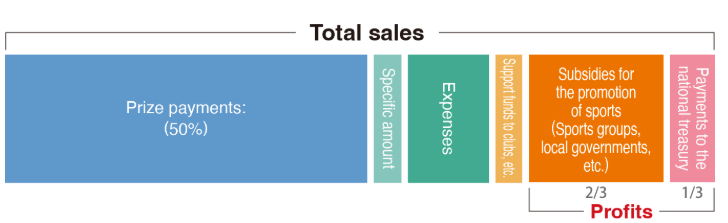
Despite their differences, both models follow the same principle: a sports-based gambling product generates revenue, and that revenue returns to the sports system.
How betting could bring more money into Canadian sport
Canada legalized single-event sports betting in 2021, and since then, the market has grown at an impressive pace. Provincial and territorial governments are already generating substantial income from betting, and some local sports organizations receive funding from regional lottery programs. However, at the federal level, this revenue is not directed toward sports, which contributes to the funding gap.
But betting could support Canadian sport in more ways than simply allocating a share of taxes or revenue. It can stimulate financial growth through several mechanisms:
- Boosting interest in less popular sports. Betting traditionally increases audience engagement. When sportsbooks offer betting lines on curling, luge, or bobsleigh, they attract attention from viewers who might not have followed these sports before. More viewers lead to more sponsors, higher broadcast revenue, and ultimately more funding for sports federations.
- Partnerships between betting companies and sports organizations. In many regions, sportsbooks become official partners of sports leagues. Such partnerships provide direct financial support that can be used for youth programs, infrastructure improvements, and development initiatives. In Canada, these partnerships are still in their early stages, but the potential is significant.
- Creating a specialized sports development fund. The Canadian government could establish a dedicated fund financed by a portion of betting-related tax revenue. This fund could support grassroots programs, youth sports, and infrastructure in remote areas. A transparent distribution system with clear criteria would ensure fair support for all levels of sport.
- Raising public awareness of the funding crisis. Sports betting can also draw attention to the challenges athletes face. When people bet on Canadian teams and athletes, they become more emotionally invested in their success – and more aware of the financial obstacles they encounter. This can increase public pressure on the government to raise sports funding.

Despite these clear benefits, many people remain opposed to expanding betting or redistributing betting revenue. The next section explores why.
What opponents of sports betting say
The main argument concerns ethics. Gambling can cause addiction and lead to serious financial and emotional harm. Should sport – an area traditionally associated with health and well-being – rely on revenue from an activity that can negatively affect some individuals?
This argument deserves serious consideration. However, it is important to note that sports betting is already legal in Canada, and the government is already collecting tax revenue from it. The issue is not whether the industry should exist, but how its income should be used. If the government has chosen to legalize betting, directing part of the revenue toward health-focused and sports-related programs is a reasonable compromise.
Furthermore, a well-designed system can include mandatory contributions to gambling harm-prevention programs. For instance, Norway requires Norsk Tipping to allocate at least 0.5% of its profits to reducing gambling-related harm.
Another argument is the instability of betting revenue. It can fluctuate based on economic cycles, regulatory changes, and market competition. Can long-term sports development rely on a revenue stream that may be unpredictable – especially given the recent trends discussed in this digest?
This concern is valid but manageable. Betting income should not replace core government funding; it should complement it. Core funding provides stability, while betting revenue can support special initiatives and innovative programs. As the market grows and matures, revenue becomes more predictable.
Final thoughts
There is a strong conceptual argument for directing betting revenue toward sports funding: betting exists because of sport. Without competitions, athletes, coaches, and infrastructure, the sports betting industry would not exist.
Sportsbooks earn money from public interest in results, from the unpredictability of outcomes, and from the margin they apply – a concept explored earlier in this article. All of these elements are created by the sports system. Therefore, it is fair that a portion of the profits generated by this industry return to the system that makes them possible.
This is not charity – it is an acknowledgment that the betting industry profits from sport. And like any industry that relies on another sector’s product, it should return part of its gains to the creators of that product.
Relevant news

Top 5 Movies That Can Offer Insights for Canadian Bettors
We all watch movies to relax and enjoy a good story – on our own…

How Sportsbook Ads Are Changing the Perception of Sports Broadcasts in Canada
In 2021, Canada legalized single-event sports betting, and in 2022, Ontario opened its iGaming market…

How Technology Is Transforming Online Sports Betting in Canada
Just ten years ago, placing a bet on a match meant visiting a sportsbook website,…

Why Canadian Bettors Prefer Bet365 and Other Key Habits
Ahead of one of the most event-packed sports years – with the Winter Olympic Games,…

The Canadian Bettor’s Calendar for 2026
2026 is set to be a busy year for sports betting fans. The main feature…

Online Betting in Canada: When Convenience Turns Into a Problem
Online betting has become firmly embedded in the habits of Canadian players. There is no…