
A New Major Player in the B.C. Gaming Scene
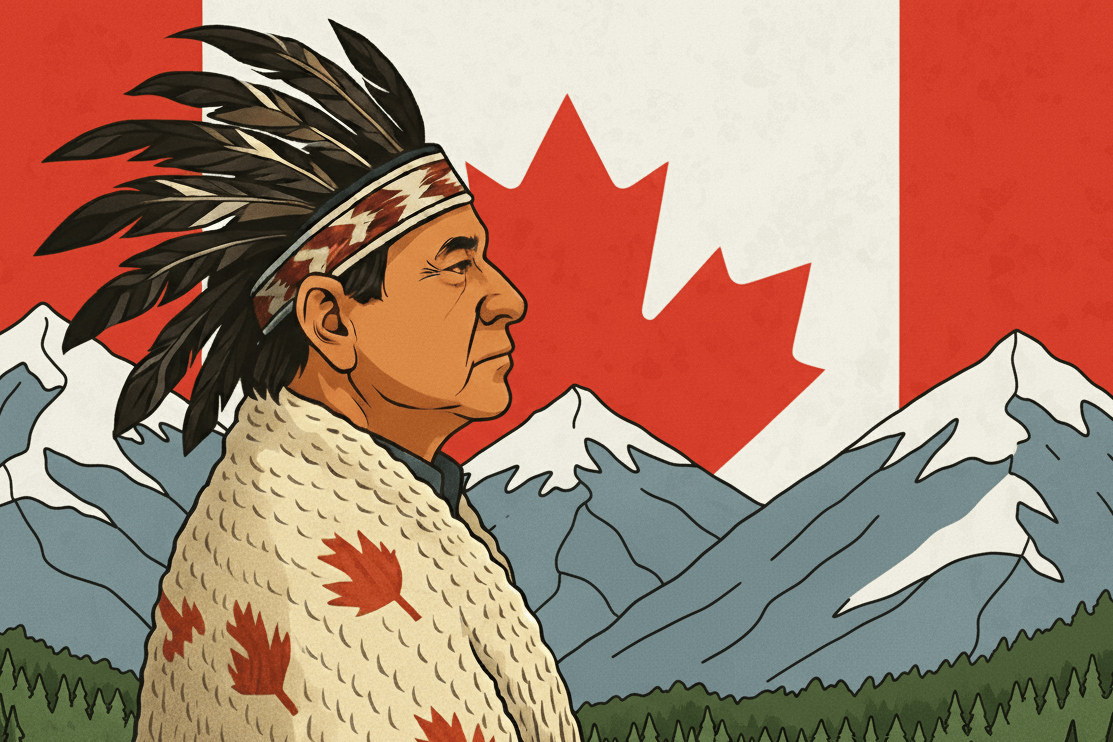
When discussing gambling and betting in Canada, it’s impossible not to mention the significant role of First Nations in shaping this landscape. Thanks to their broad autonomy, they were among the first to build this market independently of other provinces. Long ago, they recognized the importance of attracting offshore operators to increase revenue. To that end, they offered licensing under more favourable terms than the provinces – for example, without requiring a physical presence. Earlier, we covered several bookmakers that obtained their licenses from First Nations.
These measures have paid off – revenues are growing, allowing reinvestment into new ventures. One of the latest developments is that the Snuneymuxw First Nation, through its business arm Petroglyph Development Group Ltd. (PDG), has acquired four casinos in British Columbia. This move makes them the largest Indigenous-owned gaming operator in Canada based on revenue.
Such acquisitions could reshape the country’s entire gambling landscape – a topic we’ll explore in this article.
From one to four casinos in six months
The story began in June 2025, when PDG acquired Casino Nanaimo. Just three months later, in September, they purchased Elements Casino Victoria. Then, in early November, Snuneymuxw announced the acquisition of two more venues – River Rock Casino Resort and Chances Maple Ridge.
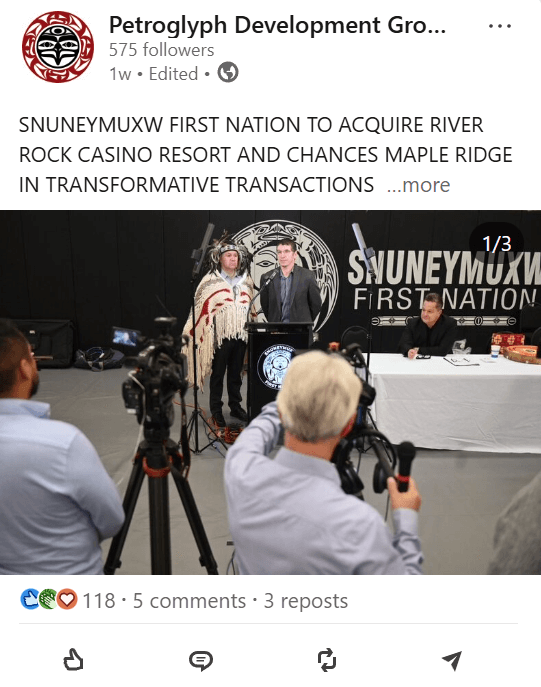
All four casinos were previously owned by Great Canadian Entertainment, one of the country’s largest gaming companies. Although the deals are still undergoing regulatory approval, one thing is clear: PDG is becoming one of the top casino operators in British Columbia in terms of revenue.
What and where Snuneymuxw acquired:
- River Rock Casino Resort – a flagship property in Richmond.
- Chances Maple Ridge – a casino in the rapidly growing Vancouver suburb.
- Casino Nanaimo – located on Vancouver Island.
- Elements Casino Victoria – in the capital of British Columbia.
This rapid portfolio expansion reflects Snuneymuxw’s strategic approach to growth. Rather than making isolated local investments, they are building a full-fledged network covering key cities across the province. It’s not just numerical growth – it’s a transition to a systemic presence in the industry, where each property strengthens the others, creating a sustainable business ecosystem.
The main goal: economic independence
“Our growing partnership with Great Canadian Entertainment has brought us to what was envisioned by our Ancestors and guided by decades of Snuneymuxw Chiefs and Councils,” said Chief Mike Wyse, Xum’silum of the Snuneymuxw First Nation. According to him, the four highly profitable casinos can serve as a foundation for long-term prosperity and economic independence. This statement highlights an essential aspect of the deal: it’s not merely a commercial expansion but a step toward restoring self-sufficiency for Canada’s Indigenous peoples.
Thus, transferring large casinos into First Nations ownership means more than a change of management. It introduces a different approach to profit distribution, community reinvestment, and potentially, a better customer experience. PDG emphasizes its goal of providing “world-class hospitality and entertainment grounded in respect for the interconnectedness of all life.”
The success of Snuneymuxw could inspire other First Nations across Canada to follow suit. Ontario, Alberta, Quebec – Indigenous groups in all these provinces are already involved in gaming, but the scale of the British Columbia deal is unprecedented. As we mentioned in a previous article, Alberta is also on its way toward transformation in the industry.
In British Columbia, gambling is traditionally tightly regulated by the provincial government through the British Columbia Lottery Corporation (BCLC). The growing influence of First Nations could eventually lead to a more flexible regulatory framework – even beyond Indigenous territories.
What does the Snuneymuxw First Nation deal mean for betting in Canada?
Although the acquired properties are traditional casinos, this deal has direct implications for Canada’s betting market. Today, single-event sports betting is fully legalized, but the regulatory landscape varies significantly across provinces. In regions like Ontario, the market is well-developed; in others, such as Alberta, it’s still in transition – and in some places, discussions haven’t yet moved beyond early stages. As a result, players are often limited to a narrow range of local options or turn to offshore bookmakers, which offer no protection in the event of disputes.
First Nations, however, hold a unique legal status and sovereignty in Canada. This enables them to offer win-win solutions for both international operators and players. They can license large offshore sportsbooks with diverse offerings while ensuring protection for Canadian users. Moreover, they can become more competitive than provincial initiatives, as strict advertising bans don’t constrain them and are open to adopting new technologies such as blockchain.
The strengthening position of First Nations in gambling could spark discussions about market liberalization and alternative licensing models. If Indigenous groups start offering advanced betting products on their territories, this could put pressure on provincial monopolies.
New operators often bring fresh perspectives. PDG already emphasizes “world-class” service. Should they decide to enter the betting sector – either through retail outlets in their casinos or online platforms – it could increase competition and improve the overall experience for Canadian bettors.
This approach isn’t new: many gaming operators integrate multiple products – casinos, poker, and sports betting. With its physical venues, PDG already has the infrastructure and customer base for a potential betting launch.
Final thoughts
The rise of large Indigenous-owned operators could transform Canada’s gambling industry. Provincial regulators, such as iGaming Ontario, operate under strict frameworks that exclude private operators without prior approval from the government. Meanwhile, First Nations territories are developing their own regulatory systems, opening opportunities to test new governance and licensing models. In this way, both land-based and online platforms backed by Indigenous communities can provide a strong alternative to provincial operators. For users, this means access to new opportunities and better service.
The coming months will reveal how this story unfolds. Still, one thing is certain: Canada’s gambling industry is undergoing significant changes, and Indigenous peoples are emerging as a powerful force in shaping its future.
Relevant news

Updated Gambling Support System in British Columbia Explained
British Columbia ranks third in population among Canadian provinces and continues to show steady economic…

Bet365 and UFC Join Forces: What Canadian Bettors Should Know
The way people watch sports and bet on them is changing fast. In early 2026,…
What Happened in Canadian Betting: February 2026
The sports betting landscape in Canada continues to shift month by month. What happens behind…

What’s Holding Quebec Back From a Competitive Betting Market?
While 73% of Quebec residents play on offshore sites, the province loses more than $300…

January 2026 Highlights: Bet365 Partnership and Other Canadian Betting Updates
The beginning of the year is not always rich in news, but that is not…

New Online Sports Betting Standards in Alberta
On January 13, 2026, Alberta Gaming, Liquor and Cannabis (AGLC) published an 85-page document titled…