
A Look Back at Canada’s iGaming News from September 2025

The iGaming landscape in Canada went through a turbulent yet exciting September. Behind the impressive numbers and market growth were stories of risk and change. Authorities uncovered a new fraudulent betting scheme, a new operator entered the Ontario online casino market, and a popular gaming platform now faces a lawsuit over gambling-like mechanisms. We take a closer look at these and other developments in this digest.
Betting gift card fraud scheme uncovered in Ontario
The Ontario Provincial Police (OPP), together with the Ontario Lottery and Gaming Corporation (OLG), uncovered a fraudulent scheme that involved using gift cards to place bets through OLG’s PROLINE sportsbook. According to investigators, thousands of cards were sold through gas stations in Thunder Bay and Sault Ste. Marie. The total losses exceeded $400,000, although the actual betting amounts were significantly lower.
The scheme resembled a form of money laundering: suspects placed large bets on both sides of sporting events, minimizing risk and keeping the funds in circulation. As a result, two residents of Thunder Bay were charged with fraud, money laundering, conspiracy, and other related offences. The case is now before the court.

This situation raises questions about the risks associated with selling betting cards. In Ontario, such cards are legally sold, and players can use them to fund accounts with licensed operators. Apart from OLG, other brands like BetMGM and Game On also offer similar products. Regulators require companies to verify customer identities and implement spending limits, yet the incident revealed that money laundering opportunities still exist. In another of our articles, we discussed a different betting-related crime – match fixing.
Record iGaming wagers in Ontario
August became a landmark month for Ontario: according to official reports, total iGaming wagers reached $8.14 billion, a 34.6% increase compared to the previous year. The $8 billion mark had been surpassed only once before – in May. Operator revenue reached $334.8 million, the second-highest figure in the sector’s history.
The growth was driven not only by an increase in active accounts (1.016 million) but also by the strengthening position of online casinos. They accounted for 89% of player spending and around 80% of total operator revenue. In August alone, players spent more than $7.2 billion on iCasino products, setting a new record. The launch of Golden Nugget Online Gaming, integrated with the DraftKings platform, also contributed to this success.
The sports betting segment showed more modest but steady growth: $765 million in player spending (+11% compared to July). Sportsbook revenue reached $60.2 million – up 28.4% year-over-year. Poker continues to hold only a symbolic share of the market (2% of both turnover and revenue).
If you want to learn more about why sports betting is currently not the most profitable segment of Ontario’s iGaming market, check out our dedicated article.
AbsoluteBet’s entry into the Ontario online casino market
Ontario’s gambling market continues to expand. In August, AbsoluteBet joined the industry, becoming the 50th regulated operator under the supervision of the Alcohol and Gaming Commission of Ontario (AGCO). By obtaining a one-year license and signing an agreement with iGaming Ontario, the company can now legally launch operations in the province. AbsoluteBet is the third new brand to enter the market this year, following Betiton and Betsafe.
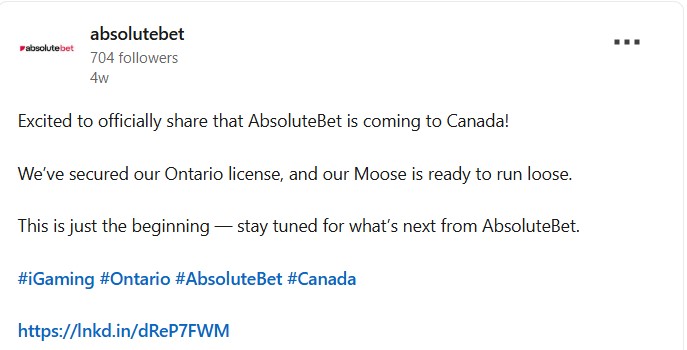
AbsoluteBet plans to officially launch by December 2025, with a strategy focused on mobile play and user convenience – key factors for competing with dozens of active platforms. The company has also expressed intentions to integrate into the local community.
Although a newcomer, AbsoluteBet’s arrival highlights the appeal of Ontario’s regulatory model. Transparent rules and strict oversight encourage brands to invest time and resources in obtaining licenses. This approach keeps the market stable and attractive – both for large international companies and for local operators.
The importance of Interac payments for Canadian iGaming operators
Localization remains a key issue in Canada’s online gambling industry – and this time, the focus is on payments. According to Cliff Nywening, Chief Operating Officer of Gigadat, many operators underestimate the importance of Interac, the national electronic payment system that is essential for operating successfully in the market.
Gigadat was among the first to integrate Interac into the gambling industry and continues to rely on it today. Nywening notes that operators who only offer credit card payments lose a significant portion of potential customers. Players dictate the terms – they choose convenient and familiar payment methods, not those imposed by companies.
Regulatory developments are also drawing attention. Currently, legal gambling is allowed only in Ontario, where more than 80 brands operate. Alberta plans to open a similar regulated market in 2026, raising hopes for greater rule harmonization between provinces. This would reduce costs and simplify adaptation for operators.
Nywening also emphasized the importance of AML (anti-money laundering) and KYC (know your customer) procedures, noting that insufficient verification can lead to account blocks and disputes. Gigadat offers automated user validation solutions to help operators avoid issues during the withdrawal process.
Lawsuit against Roblox over gambling-like mechanisms
A class-action lawsuit has been filed in British Columbia against the gaming platform Roblox, as first reported by CBC News. The plaintiff – the father of a 12-year-old child – claims that the game uses gambling-like mechanisms that foster addictive behaviour and encourage spending.
According to the lawsuit, the child began playing Roblox at around age five or six and now spends about two hours a day using various devices. The complaint lists symptoms such as irritability, mood swings, loss of interest in other activities, and difficulty concentrating. The family says they have spent up to $500 on the platform’s virtual currency, Robux.

Lawyers pointed to game mechanics such as spin-the-wheel contests and mystery boxes, which they argue mirror gambling behaviour because they rely on random rewards. These features, they claim, are particularly harmful to children, who cannot fully understand the financial risks involved.
Roblox, however, argues that all purchases are voluntary and that free gameplay remains available. The court will now have to determine whether Roblox’s in-game economy misleads users and encourages excessive spending.
This case raises broader questions – namely, where the line lies between entertainment and covert gambling. If the court sides with the family, the ruling could have far-reaching consequences for the entire microtransaction-based gaming industry – including both traditional and gambling-related titles. Discussions around regulation in Canada are already active, and cases like this only intensify the debate.
Relevant news

Updated Gambling Support System in British Columbia Explained
British Columbia ranks third in population among Canadian provinces and continues to show steady economic…

Bet365 and UFC Join Forces: What Canadian Bettors Should Know
The way people watch sports and bet on them is changing fast. In early 2026,…

What Happened in Canadian Betting: February 2026
The sports betting landscape in Canada continues to shift month by month. What happens behind…

What’s Holding Quebec Back From a Competitive Betting Market?
While 73% of Quebec residents play on offshore sites, the province loses more than $300…

January 2026 Highlights: Bet365 Partnership and Other Canadian Betting Updates
The beginning of the year is not always rich in news, but that is not…

New Online Sports Betting Standards in Alberta
On January 13, 2026, Alberta Gaming, Liquor and Cannabis (AGLC) published an 85-page document titled…