
How AI Pushes Canadians Toward Betting
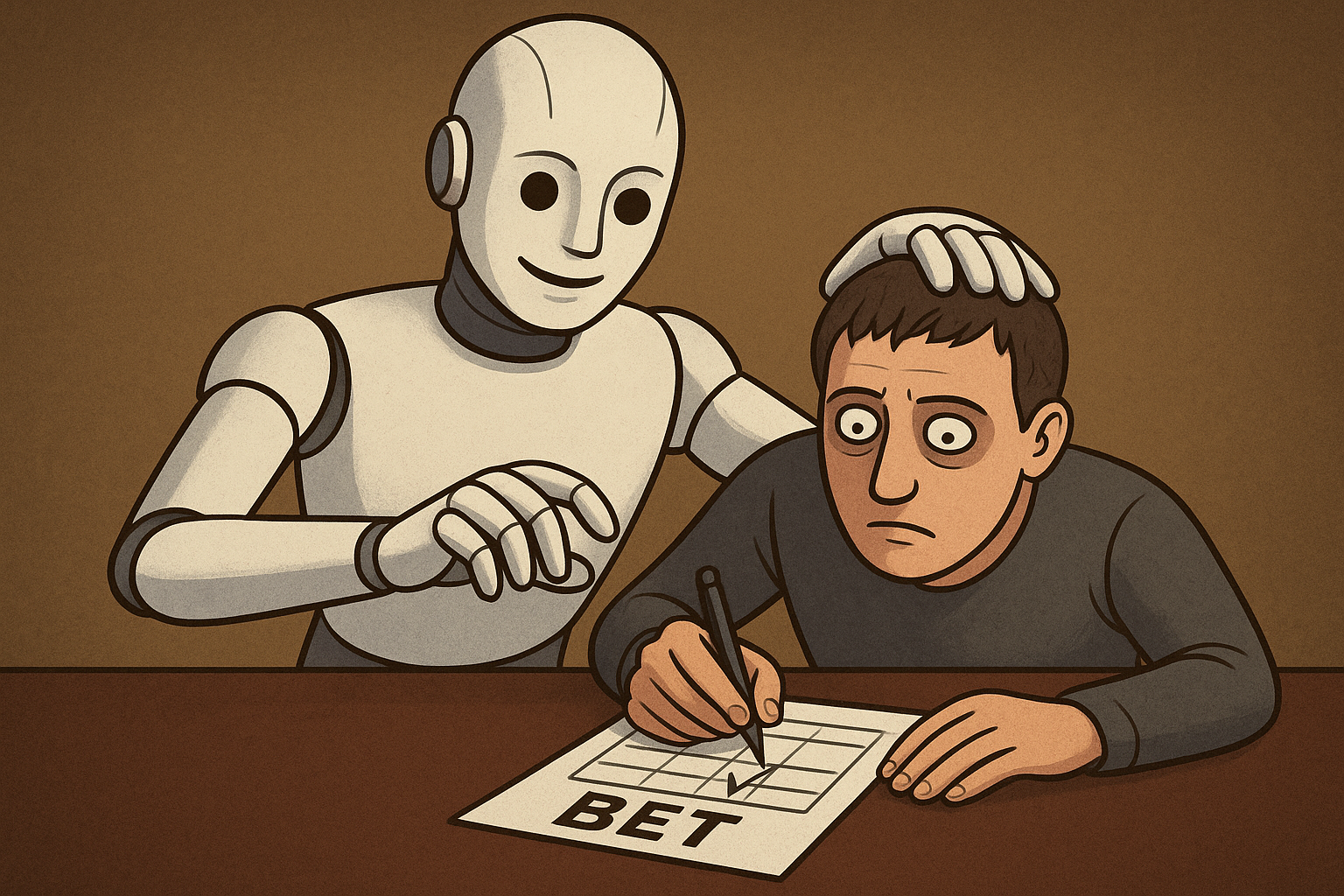
A major global trend of recent years is the growing popularity of AI-powered chatbots. Millions of people and businesses use ChatGPT and similar tools for all kinds of tasks. In a previous article, we already discussed how bookmakers integrate AI into their platforms. Canadian bettors also turn to chatbots for hints – such as which team to choose or what betting strategy might work best. Google Trends shows that queries like “AI sports betting predictions” have surged by 200–5000%. Entire services have appeared where algorithms analyze data and generate forecasts.
At first glance, it seems convenient: ask a question – get an answer. The problem is that AI doesn’t understand the real nature of betting. It generates information based on what it finds online and often distorts it. Yet it sounds confident. And that can be dangerous – especially for beginners or for people struggling with gambling addiction.
Why chatbots continue talking about betting even when addiction is mentioned
One of the most troubling cases occurred this year. Journalist Jon Reed asked ChatGPT and Gemini how to cope with problem gambling. The bot initially offered recommendations on limiting betting. But when the same user returned to the conversation after a few messages and mentioned sports again, the chatbot began giving specific betting tips for a football match.
Why does this happen? Language models operate on conversational context. If a person repeatedly mentions betting, teams, or predictions, the algorithm starts treating this topic as a priority. Safety filters that should block gambling advice after addiction-related queries often fail to trigger. The context shifts – and the AI essentially forgets that the user previously asked for help.
For those working in machine learning, this is a technical issue. For users, it’s a real risk. A chatbot doesn’t understand the consequences of its words. It doesn’t care what happens next. It simply responds based on statistical patterns.
How can such answers harm people trying to overcome a gambling addiction?
For someone trying to manage a gambling addiction, any trigger can lead to a relapse. Sports betting activates the same neurochemical reactions as other forms of addiction. At first, a player experiences dopamine, adrenaline, and a sense of control. Then comes the crash, shame, and the urge to chase losses.
Chatbots don’t see this dynamic. They don’t understand that advising on how to win back money to a person with an addiction is not “just information.” It’s an invitation to return to the cycle they are trying to escape.

Mental health is receiving growing attention in Canada. Provincial governments and community organizations emphasize that gambling is not merely entertainment. According to 2018 statistics, 1.6% of Canadians fall into the moderate-to-severe risk group for gambling-related problems – about 304,000 people. After the legalization of single-event betting, these numbers have likely increased.
Chatbots worsen this issue. They are available 24/7, don’t ask uncomfortable questions, and never judge. That’s convenient for information seekers – but for problem gamblers, it’s like a bar that never closes for someone struggling with alcohol.
A 2025 study showed that AI can even display patterns characteristic of people with gambling addiction. Bots increased bets after losses and continued playing despite negative outcomes. If such models are used to advise people, they may unintentionally reinforce the very behaviours that problem gamblers are trying to overcome.
Why AI betting advice doesn’t work in real-world decisions
Even setting ethics aside, AI betting advice is fundamentally ineffective. ChatGPT, Gemini, and similar models have no access to real-time data. They don’t know who’s injured, what the weather is like, or what internal issues a team is facing. All they can do is process text found online in the past.
Industry experts confirm: these tools are not designed for predictions. Robert Kraft, CEO of Atlas World Sports, acknowledges that chatbots seem reliable to casual bettors because they can process huge amounts of information quickly. But he states clearly that AI cannot be trusted – it doesn’t account for the unpredictability of sports and, most importantly, generates plausible-sounding predictions that aren’t supported by actual statistics, misleading users.
Professional (sharp) betting platforms use AI completely differently. They combine statistical models with expert analysis. Algorithms help detect patterns, but humans always make the final decision.
Who is responsible for AI giving betting advice to Canadians?
The question of responsibility remains unresolved. AI developers, bookmakers, and regulators all speak about user protection, but problems persist.

OpenAI and Google integrate safety filters into their models. In theory, a bot should recognize addiction-related queries and offer help instead of betting advice. But as recent cases show, the system fails. The conversation’s context shifts priorities, and the filter doesn’t activate.
Canadian regulators also try to respond to factors that may fuel gambling addiction. There haven’t been AI-related cases yet, but in 2024, Ontario’s Alcohol and Gaming Commission banned betting ads featuring athletes and celebrities, as influencers strongly impact bettors. Yet videos featuring the same stars promoting “responsible gambling” appeared days later – creating a loophole. It’s possible something similar could happen with AI.
Additionally, provinces regulate the market differently. Ontario allows private companies to operate under iGaming Ontario supervision, Quebec blocks access to unlicensed sites, and British Columbia runs everything through BCLC. There is no unified system, which means finding a solution may take years.
AI developers say their models are general-purpose tools. Bookmakers argue they can’t control how users interact with chatbots. And regulators are only beginning to address the issue.
Why the use of AI for betting matters to the Canadian online community
AI is evolving rapidly. New models, features, and applications appear every month. For most people, this is convenient. But in the context of betting, these technologies introduce specific risks that can’t be ignored.
Canada is a country where around 65% of the population bets at least once a year. Online betting is growing faster than any other segment. Young people are especially active: among those aged 18–29, one in three bets online, and 23.5% report significant harm – from losing savings to accumulating credit-card debt.
In this environment, chatbots that appear intelligent and helpful but don’t understand the consequences of their answers become a problem. They can’t replace professional analysis, they can’t help with addiction, and they can increase risk for vulnerable groups.
Supporting such users must remain a priority. This applies not only to developers and regulators, but to everyone. If you know someone struggling with addiction, remind them: a chatbot is not an expert. It’s just an algorithm.
If you or someone you know needs help, contact the Responsible Gambling Council of Canada. Professional support is always better than advice from an AI. In one of our articles, we discussed how to recognize signs of gambling addiction.
And remember: betting isn’t a way to earn money – it’s a form of entertainment. If it stops being fun, it’s time to step back, not turn to a chatbot for advice.
Relevant news

Updated Gambling Support System in British Columbia Explained
British Columbia ranks third in population among Canadian provinces and continues to show steady economic…

Online Betting in Canada: When Convenience Turns Into a Problem
Online betting has become firmly embedded in the habits of Canadian players. There is no…

Why Canadian Youth Are Vulnerable to Problem Sports Betting
With the introduction of a regulated gambling market, sports betting has rapidly expanded across Canada.…

Marketing Strategies and Psychological Tricks Bookmakers Use on Canadian Bettors
According to a survey by Ipsos Canada, 30% of Canadians are registered on at least…

Young Canadians and Betting: How Education Can Help Prevent Gambling Harm
Gambling, including sports betting, has become an integral part of the digital world – where…

How Artificial Intelligence Is Used in Betting in Canada
Artificial intelligence is gradually transforming the betting industry in Canada. Local operators are increasingly adopting…